
EISCAT operates some of the world's most advanced facilities for incoherent scatter radar. We are located above the Arctic circle in the Nordic region.
Pioneering radar technology for a resilient planet
The first EISCAT system was commissioned in 1981. Since then, our facilities have been continuously developed and expanded. Today it consist of world-leading incoherent scatter radar stations and an advanced ionospheric heating facility. All located in the northernmost part of the Nordic region in the Arctic.
EISCAT offers unique conditions for research in several fields. Our radar measurements make it possible to study phenomena such as the northern lights (aurora borealis), space weather and space debris, as well as atmospheric dynamics. Read more about the science here: The Science of EISCAT. All our radar stations are working together, providing researchers with unique opportunities for advanced studies in multiple dimensions.
EISCAT radars are used as both incoherent and coherent scatter radars to:
- study the properties and instabilities of the ionosphere.
- investigate the structure and dynamics of the atmosphere.
- conduct ionospheric modification experiments with the heating facility.
All data from our radar stations is only used for civil research.
Advanced research radar facilities in the Arctic
We are building a new next generation incoherent scatter research radar facility, to replace the old EISCAT system. EISCAT_3D is not yet operational.
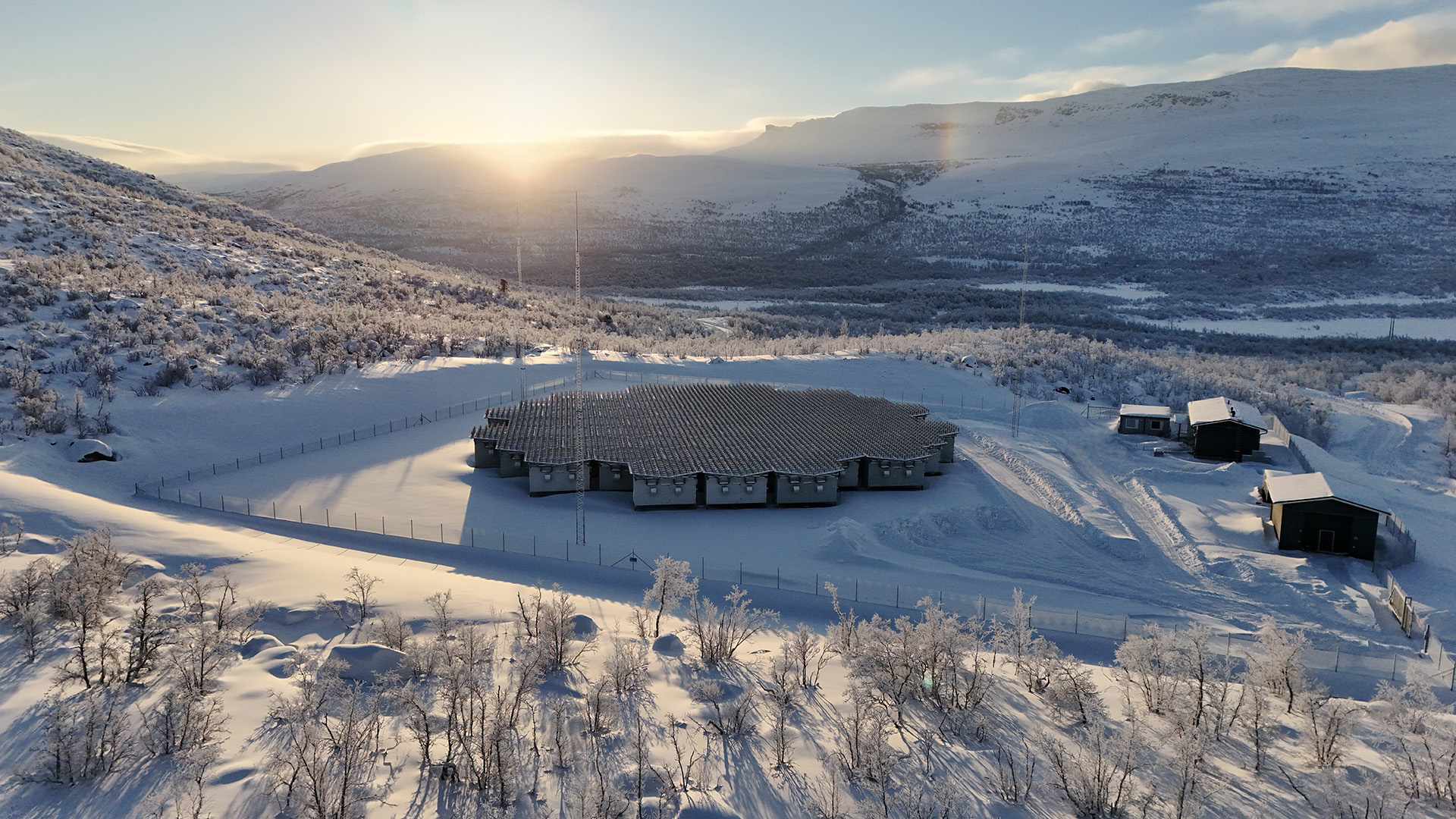
EISCAT_3D Kaiseniemi, Sweden.
Photo: Johan Svensson, 2024
Transition from EISCAT Scientific Association to EISCAT AB
EISCAT was founded in 1976 as a non-profit scientific association, formerly named EISCAT Scientific Association. The mission was to conduct research on the lower, middle and upper atmosphere and the ionosphere using incoherent scatter radar technique. This technology is the most powerful ground-based tool for such studies.
At the end of 2024, EISCAT transferred its assets to a Swedish limited company – EISCAT AB. The new company officially took over operations on 1 January 2025. The transition was motivated by both legal and security needs, particularly related to the development of the new EISCAT_3D radar system, and resulted in a more robust corporate structure.
The transition to a limited company was driven by changing legal requirements, as a result of EISCAT starting the construction of the EISCAT_3D infrastructure. The limited company form facilitates higher requirements for security, governance and finance compared to the previous association model. EISCAT AB is now a state-owned company with Sweden, Norway and Finland as owners. Other organisations, internationally, can apply to join as associates or affiliates. This structure provides a clearer division of responsibilities, more efficient decision-making and greater financial transparency – important factors for multinational scientific infrastructure.